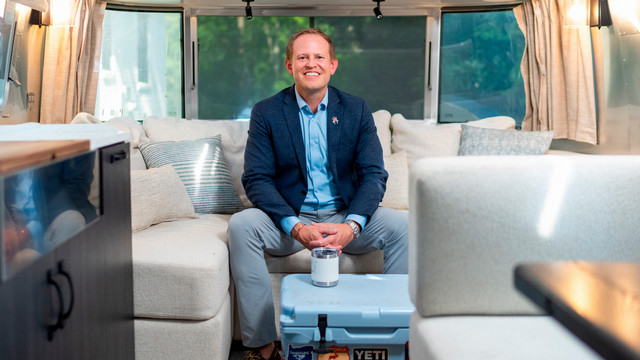
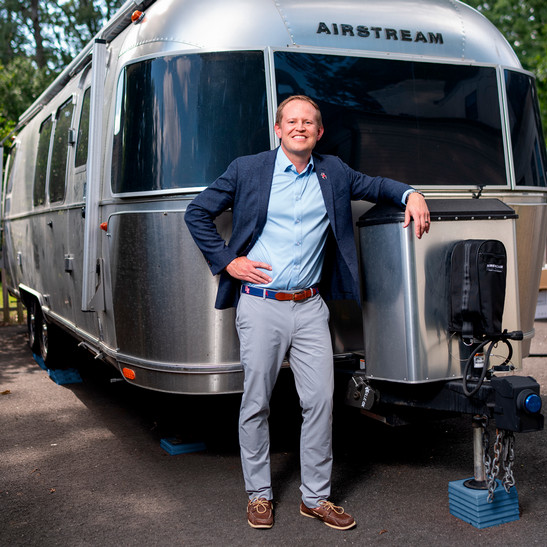
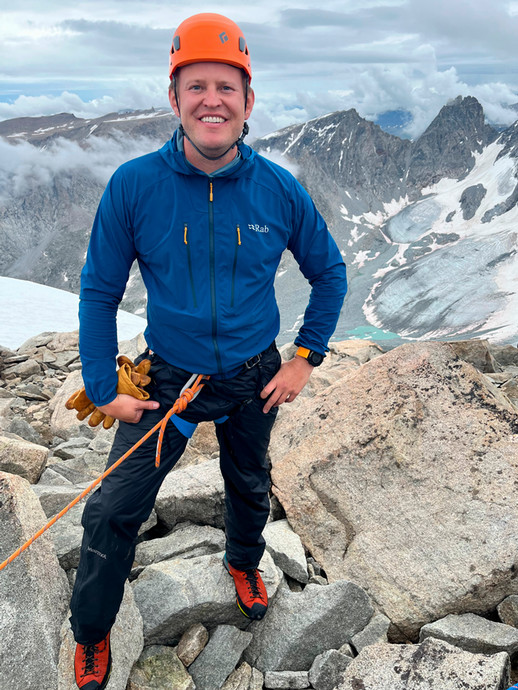
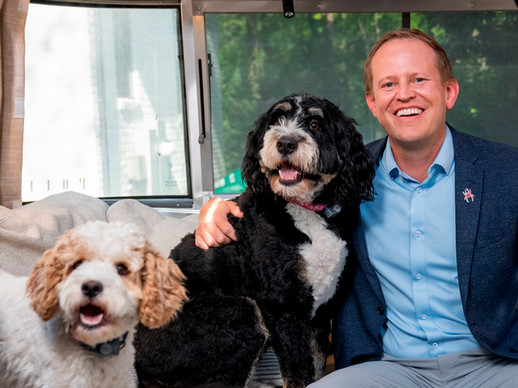
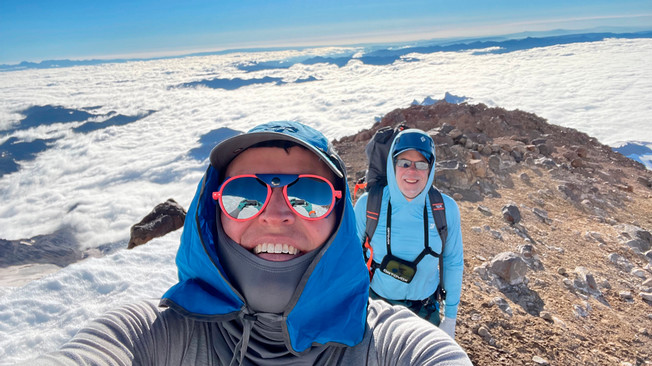
Jacob Rooksby enjoys summiting remote mountain peaks and camping in his Airstream. He’s also the new dean of University of Richmond School of Law. With an empathy-forward mindset, Rooksby’s leadership approach starts with helping others feel seen and valued as they are — a method he’s found that cultivates professional and legal excellence.
Over the summer, Jacob Rooksby joined the Richmond Law community as the school’s new dean. A College of William & Mary and University of Virginia graduate, he returned to the commonwealth after serving as dean at Gonzaga University School of Law. Rooksby was previously an associate dean of administration and associate professor at Duquesne University School of Law. He has Richmond ties, too, as a former attorney for McGuireWoods LLP.
► Welcome to Richmond Law. What are you listening for?
I’m listening for what people value most about this community and what opportunities they see for growth.
Richmond Law is already thriving. My goal isn’t change for its own sake. It’s learning how we can take something excellent and make it even better.
► What are you most excited about at Richmond?
Honestly, I’m excited to meet students and get to know them.
Building relationships is one of the most rewarding parts of this work. I’m looking forward to experiencing the energy of the community.
► What do you see as the aim of legal education?
Legal education is about preparing students for a profession that is rapidly changing.
We, as faculty, have the obligation to focus our students’ time with us on building wisdom, judgment, empathy, compassion, humor, and all the other human qualities that distinguish the best attorneys and judges in the age of AI. Richmond’s high-touch, residential, liberal arts-based community is the perfect setting to meet the demands of this moment in legal education.
We must also recognize that the legal profession historically has been marked by exclusion and high barriers to entry. I think it’s on us to lower those barriers, lower the anxiety, and look for ways to create a culture where students can flourish. Part of that is by showing up as our authentic selves and not as stereotypes of what lawyers or legal professionals “should” be like.
“As a leader, it’s important to remember that people come to work as whole human beings.”
I think for a student to thrive, they need to understand the language of different ecosystems that exist in the profession. The language, culture, and demands of judges, for example, are very different from those of public defenders, from prosecutors, from large law firm lawyers or smaller law firm lawyers. It’s on us to cultivate an anthropologist-like look at both the commonalities and the tensions at play. Part of our role as educators is to paint that complex picture for students.
A quote attributed to the late Justice Oliver Wendell Holmes Jr. brings this home: “Life is painting a picture, not doing a sum.” Richmond Law provides the paint and paintbrushes — the skills, knowledge, history, appreciation, and context — for students to create masterpieces out of their lives and careers.
► How did your J.D. and legal career emerge from your Hispanic studies degree?
It’s from love of language, which I think is a great background for law. I ended up practicing intellectual property law, which is all about the meaning of words, how we’re conveying and capturing ownership of ideas. The nuance of language continues to fascinate me.
► What might we be surprised to learn about you?
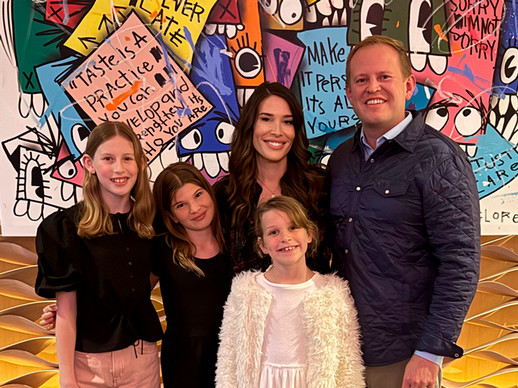
I’m probably more emotional than people expect. If you ask my wife and daughters, they will tell you that I’ve always been the crier in the family. A great movie or a powerful story gets me every time. I think people sometimes assume leadership requires a certain toughness, but I’ve always seen sensitivity as a strength.
Friends would probably say I have a pretty big heart, and I’m perfectly happy for that to be true.
► Career aside, what lights you up?
Time with family, our dogs, and being outdoors. I’ve always loved hiking, camping, backpacking, and exploring new places.
For years, I’ve been working toward a personal goal of hiking the highest point in every state. One of the things that drew me back to Virginia is its natural beauty — I just love it.
► Growing up, who modeled the kind of humanity and leadership you try to practice today?
I was fortunate to have professors at William & Mary who saw potential in me before I saw it in myself.
One professor in particular, George Greenia, encouraged me to major in Hispanic studies and eventually pursue an academic career. George treated me less like a student and more like a future colleague.
That experience of being truly seen was transformative. It taught me how powerful it is when a person takes the time to recognize possibility in another. It’s something I’ve tried to carry forward in my own leadership.
► What experience most shaped your capacity for empathy?
Without question, the biggest was my late wife Susan’s cancer diagnosis.
We were both just beginning our careers when she was diagnosed with Stage 3 cancer at age 30. Suddenly we were navigating something overwhelming in a new city where we barely knew anyone. The support we received from colleagues and our community made a lasting impression on me.
That experience, and later losing her in 2022, taught me that everyone is carrying something. It may be grief, illness, family challenges, or struggles we can’t see from the outside.
As a leader, it’s important to remember that people come to work as whole human beings. Understanding that has made me more empathetic and more grounded in what really matters. And I’ve come to believe that if we want cultures where people feel comfortable being human, leaders must model that first. Showing vulnerability creates space for others to do the same.
► How do you lead with humanity?
When I first became a dean, I quickly realized that while difficult decisions often get pushed to people with titles, simply making decisions for people isn’t usually the most effective approach. Leadership is a mindset and a way of being; it’s not about a title. I found fulfillment in trying to change the system such that people feel empowered to make their own decisions. It’s not an abdication of responsibility — it’s about cultivating the talent that is there.
“Leadership is a mindset and a way of being; it’s not about a title.”
I’ve seen organizations flourish when people feel trusted, supported, and able to exercise their own expertise. Perhaps what I’m most proud of from my previous work at Duquesne and Gonzaga isn’t any particular initiative — and I had the chance to start groundbreaking clinics and centers and prompt meaningful changes. It’s helping build cultures where people feel safe, seen, and empowered to thrive — where people feel free to show up as who they are rather than as a stereotype of who they think they’re supposed to be.
► How do you hope the community will experience your leadership?
I hope people feel that I genuinely care about this community and about them as individuals.
We won’t always agree on every issue, but I want people to know that their perspectives matter and that they’re part of a community where they can be themselves. One of the things I value most about a place like Richmond is that people with very different backgrounds and experiences can come together around a shared purpose. I want to help strengthen that sense of belonging. ■