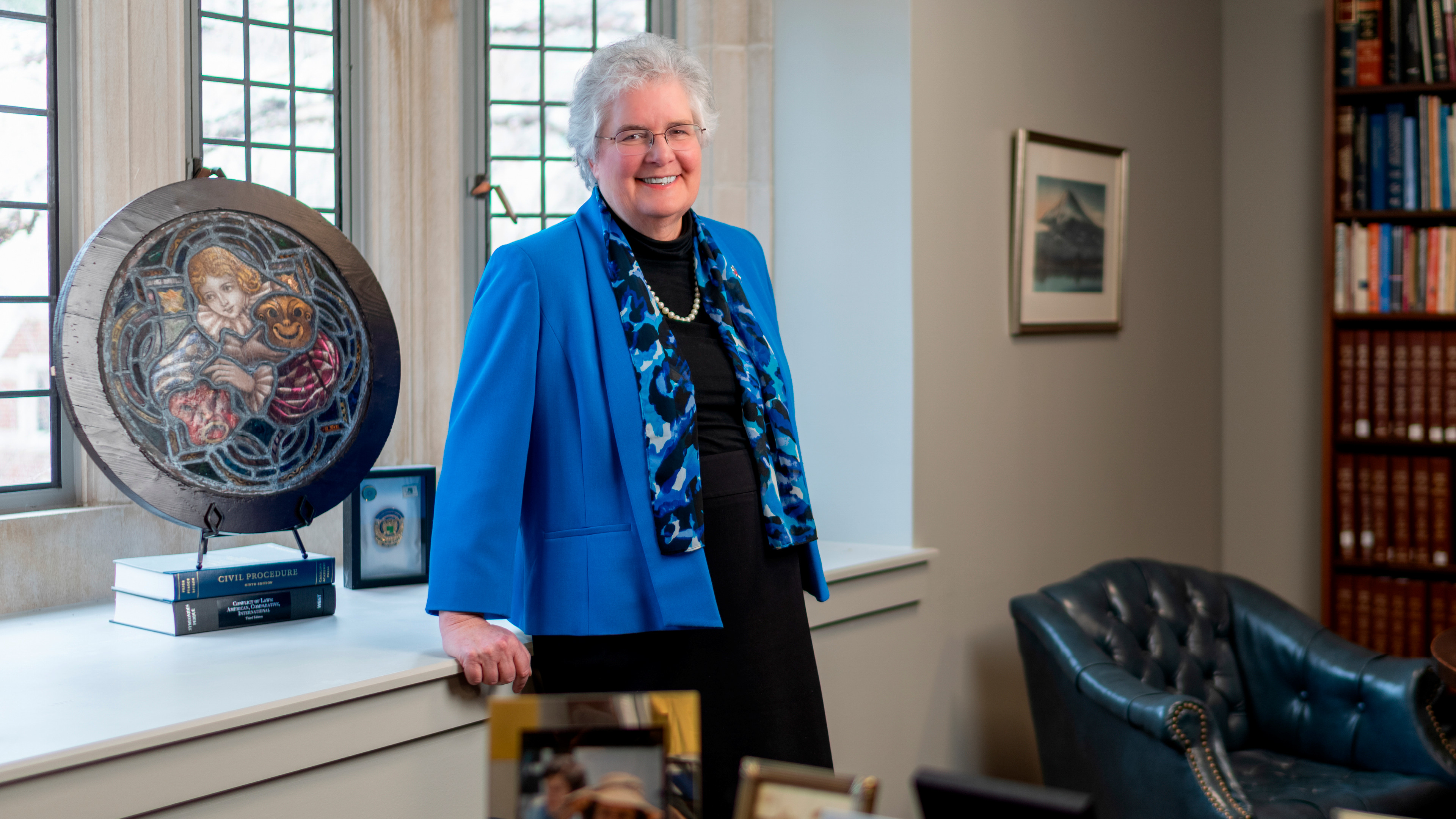
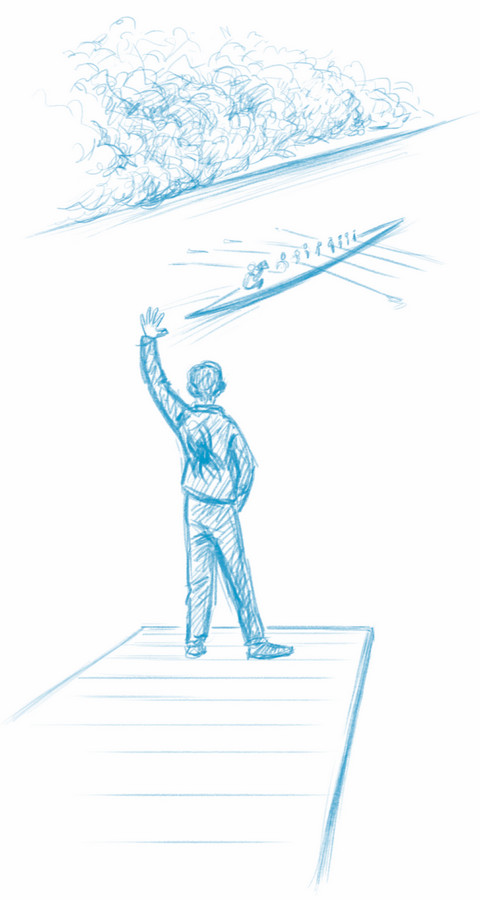
Picture this: A racing shell cuts through still water, eight rowers in perfect synchrony as their blades slice the surface in one clean, collective motion.

At the stern sits the coxswain. This person never touches an oar. Instead, they call the rhythm, read the water ahead, and steer the shell toward a finish line that the rowers — facing backward — cannot see. The cox does not row. But without the cox, the boat moves without aim.
When Wendy Perdue describes her 15 years as dean of the University of Richmond School of Law, she reaches for this image. She rowed as an undergraduate at Wellesley College, and the sport left its mark on how she approaches leadership.
“In a crew shell, the coxswain steers and encourages people to do what they’re doing,” Perdue says as she sits in her office, her voice measured and deliberate as always. “But all the work is done by the people rowing. It’s not done by the cox. The dean is like the cox — steering the boat, trying to set the pace — but the work is done by other people.”
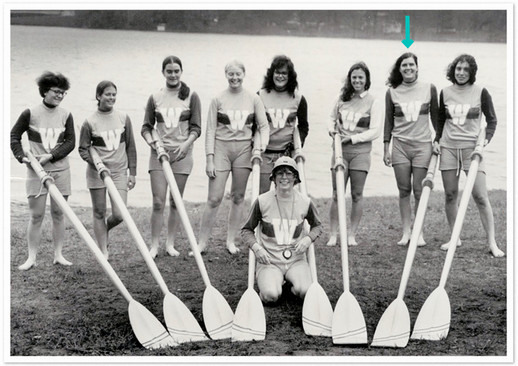

It is characteristically humble framing from a dean who has, over the course of her tenure, assembled one of the most accomplished faculties in the law school’s 156-year history. She led them with the quiet authority of someone who already sees what’s coming — and has thought very carefully about what to do when it arrives.
When Perdue steps down at the end of June, she will be the fifth-longest-serving law school dean in the nation. She leaves behind an institution she has fundamentally transformed. Yet ask her colleagues what she’ll be most remembered for, and they reach, unanimously, for the same four words: good for the students.
A quiet leader in stormy waters
Perdue arrived at Richmond Law in 2011, and the timing was more than a little tricky — but she saw it as opportune. Between 2011 and 2015, the number of students applying to law school nationally declined by roughly 40%. Many schools retrenched, froze hiring, and hunkered down. Perdue looked at the same storm and saw a different option.
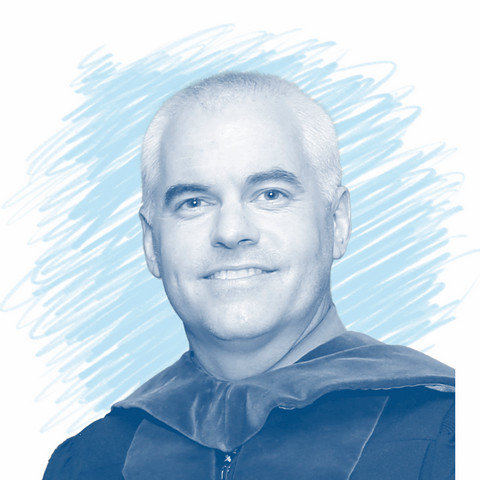
“She’s very good at recognizing the opportunity in crises,” says Jim Gibson, Sesquicentennial Professor of Law, who has been on the Richmond Law faculty throughout Perdue’s tenure. “When not as many people are applying to law schools, maybe you have a smaller class — but that has other benefits. She was smart about saying, ‘Let’s recalibrate, not just with revenue impact in mind, but seeing if we can actually improve the institution by making investments at a time when everyone else is in full retreat.’”
“She’s ambitious for everyone but herself.”
What she did next became, in the estimation of her colleagues, the defining strategic move of her deanship. While peer institutions cut back on faculty recruitment, Perdue persuaded Richmond’s central administration to keep hiring. The result: By around 2018, Richmond Law had more junior faculty than almost any other school in the country. Today, the majority of the law school’s faculty — and over 90% of its employees — were hired during her tenure.
“At a time when other places are treading water, that’s a good time to try and move ahead,” says university president Kevin F. Hallock, paraphrasing the logic that guided the university’s support for Perdue’s approach. “And Wendy’s ability to attract and retain exceptional faculty is a huge mark on the school.”
Joan Saab, university provost, puts it even more directly. Perdue regularly prepared spreadsheets that mapped out the intricate chess game of endowed chairs, professorships, and faculty fellowships, moving resources with the precision of someone who had done the math six different ways before walking in the door. “She’ll say, ‘If I move this person to this professorship, then I can think of that person for this chair, and it frees up faculty salary here so that I can make a retention offer for this other person,’” Saab says. “She’s very strategic.”
The sign on her desk
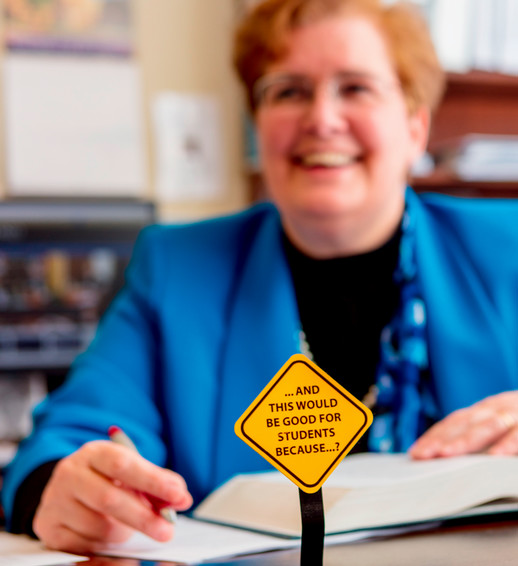
There is, prominently displayed on Wendy Perdue’s desk, a small sign. It reads: “...And this would be good for students because...?”
It is not a rhetorical flourish. It is, by every account from those who have worked with her, a genuine operating principle — a filter through which every decision passes before it is made. Hallock encountered a student who, at an open session, submitted a question asking how the university thinks about students in its decision-making. The question struck Hallock as revealing: The student didn’t know that all decisions were supposed to be about students. Perdue’s sign announces this as the foundation of law school decision-making to anyone who comes in her office.
Dean Sandra Peart of the Jepson School of Leadership Studies, who has worked alongside Perdue for years in academic cabinet and informal deans’ lunches, adopted the question herself after observing how Perdue wielded it. “It’s so simple and yet so important and powerful,” Peart says. “It shouldn’t be surprising because this is why we’re at a university. But the simplicity of it — the elegance of it — is refreshing.”
She adds, laughing, that if she’s wrestling with a problem at her own desk, Perdue is a colleague she doesn’t hesitate to call — not because Perdue tells her what to do, but because Perdue asks the right questions until Peart finds the answer herself.

“This school is in great shape because of her.”
“As a dean,” Peart says, “there aren’t many people you can call. You can’t always involve an associate dean, someone who’s your direct report. You can talk to them about a lot of things, but not about everything. You want to talk to a dean. And there are five of us here [at Richmond], five academic deans. This isn’t to say I don’t also call the other deans — Jennifer [Cavenaugh], Mickey [Quiñones], and Jamelle [Wilson] — but I will miss being able to get Wendy’s advice.”
Gibson confirms that this guiding principle was evident from Perdue’s very first act as dean. Conventional wisdom holds that new deans use their opening moment to ask for more tenure-track faculty lines. Perdue looked around the school, listened to alumni, and did something unexpected: She asked for money to transform the legal writing program.
Adjunct instructors — practicing lawyers working a few hours a week — had been running the program. Under Perdue’s leadership, the school hired five full-time faculty dedicated to rigorous instruction in legal analysis and writing. “That’s the last thing that’s going to get you any cred on the sort of national prestige scale,” Gibson says. “But it was absolutely necessary for the students. And to me, that’s the earliest example of when I thought, ‘Yeah, this is going to be a different sort of deanship from the typical. She’s ambitious for everyone but herself.’”
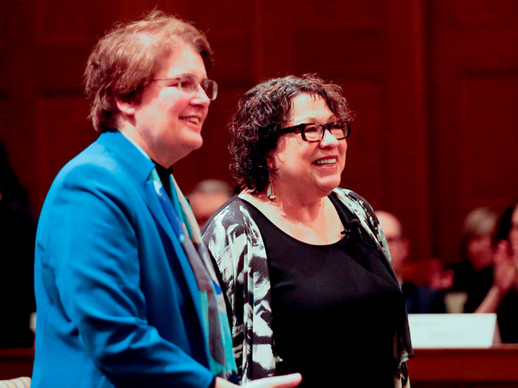
Perdue with Supreme Court justice Sonia Sotomayor.
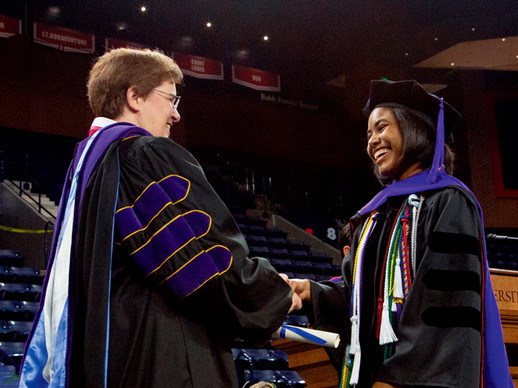
Commencement 2019
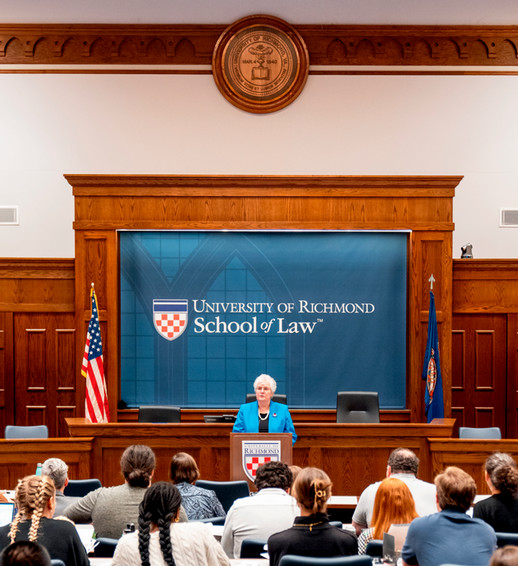
Wendy introducing Erwin Chemerinsky at the Sharp Speaker Series in 2024.
“She’s the GOAT of law school deans.”
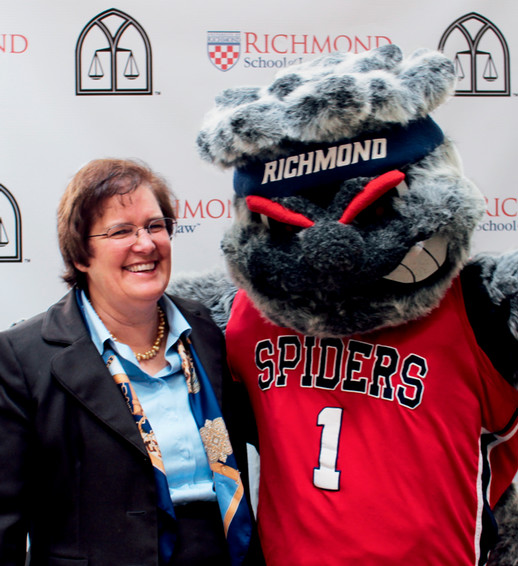
With WebstUR
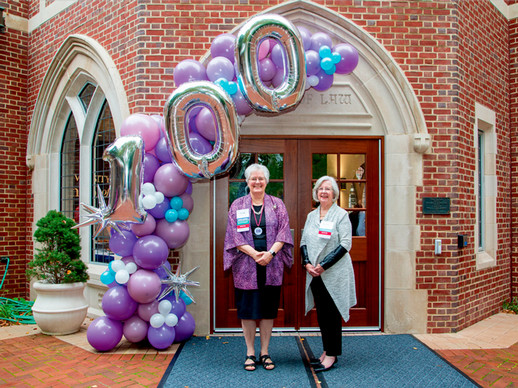
Wendy with Mary Lou Kramer, L’75, lead donor to the Law Women’s Centennial Scholarship.
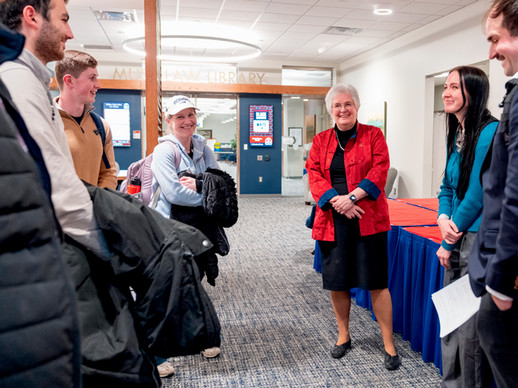
With students in the renovated law school commons
Get with the program
Of all the initiatives that recur across interviews with Perdue’s colleagues, students, and university leadership, one comes up with striking consistency: the Professional Identity Formation program. Launched in 2020, it became the signature student-facing achievement of her deanship — and a national model.
Every first-year student at Richmond Law now takes a course that has them reflect on their strengths, values, and motivations while engaging with the ideals and responsibilities of the legal profession. That reflection continues throughout their education, reinforced through clinics, externships, and upper-level courses on leadership and ethics. Crucially, Richmond implemented this program well before the American Bar Association made it mandatory.
“We were [excelling at] this type of student support before it was an ABA requirement,” Saab says. “Now all law schools have to do it, but we chose to do it. I think that difference is key.”
For Libby Larro, L’26, president of the Student Bar Association during Perdue’s final year as dean, the program was personally transformative. After obtaining an undergraduate degree in religion, she came to law school wondering, “When I’m in a 1L law class learning about contracts, how will this knowledge not only help me be a better lawyer, but also be a better person?” The professional identity curriculum answered that. Larro said it showed her, “Here are all these legal skills you’re learning right now and how you can apply them to serve clients and the people around you.” Larro went on to mentor incoming students through the program’s peer mentorship component, closing a circle of learning Perdue had deliberately designed.

“We have more nationwide recognition for all the really great things that are happening … definitely a testament to Dean Perdue.”
The program also connects to one of Perdue’s deepest commitments: ensuring that students from all backgrounds have access to the full law school experience. When she arrived, students from first-generation or lower-income families were less likely to pursue unpaid legal internships in their first summer — not because they lacked ambition, but because they lacked financial support. Perdue made it a priority to guarantee every student a summer grant for public interest work.
That grant has grown from $2,000 to $5,000 during her tenure, and today more than 90% of students work in law-related positions in the summer after their first year. “I wanted every student who was interested in getting law experience that first summer to be able to do that,” she says. “And I didn’t want it to be limited to those who happened to have connections through their family or who could afford to work for free.”
Funding this sort of law school program is no easy feat. Kelley Hodge, L’96, takes special pride in supporting Perdue’s efforts through her leadership on the alumni board. “While there are many other things required of a dean,” she says, “there’s the need to generate commitment from those able to support the law school financially. Someone can only make that ask and get that commitment if the individual believes that person is moving the school in the right direction.”
A community built to last
Perdue did not set out to become one of the longest-serving law school deans in the country. She simply arrived with a clear-eyed sense of what needed to be done and a methodical approach to doing so. The years accumulated as the result of a series of decisions to stay through one more challenge: through the admissions falloff in the early 2010s, through the COVID-19 pandemic, through the school’s major building renovation in the early 2020s that stretched longer than expected, and through the ABA reaccreditation visit that concluded in March of 2025.
That visit ended at 11:45 a.m. on a Wednesday. At noon, Perdue convened a previously scheduled faculty meeting. She walked in and told them: “I told you I’d stay through the visit. They all left 15 minutes ago. I’m going to step down.”
Perdue gave a year’s notice — enough time, she reasoned, for the university to conduct a genuinely excellent search for her successor.
The longevity of her tenure, she reflects, made possible a style of leadership she describes with reference to the philosopher Xiao Ling, who spoke of a leader who guides change so that when the work is done people say, “We’ve always been like this.” That, Perdue says, is her model. Not dramatic, sweeping transformation, but slow, deliberate, nearly imperceptible change. “If folks come away not noticing changes and instead thinking we’ve always been like this, I view that as a success.”
Hodge frames the school’s evolution differently but arrives at the same conclusion. “Wendy has been a very deliberate, thoughtful, caring leader of the law school,” Hodge says. “She has been a driving force through incremental steps, and that has kept me involved and engaged. I’ve remained committed to the law school since graduating in 1996 because I know that they are committed to the mission and to the students.”
What Perdue built, her colleagues agree, is not just a stronger institution, but a culture. Faculty stay. Staff stay. Associate deans who worked directly under her continue in distinguished careers, in no small part because of the support and autonomy she gave them. And the students — the ones for whom every decision was ultimately made — leave better prepared, better supported, and better connected to the profession.
“This school is in great shape because of her,” Saab says. “She’s the GOAT of law school deans.”
Larro, a member of the final graduating class under Perdue’s tenure as dean, says Richmond Law is having a moment. “We have more nationwide recognition for all the really great things that are happening,” she says, “and the fact that we have gotten to that point over the past 15 years is definitely a testament to Dean Perdue.”
“If folks come away not noticing changes and instead thinking we’ve always been like this, I view that as a success.”

What the coxswain leaves behind
There are things about Perdue that don’t quite fit the formal profile. She has a wit that colleagues describe as dry, quick, and genuinely surprising given how relentlessly serious she presents in professional settings.
“She’s so focused, then she’ll slip in something irreverent, and it’ll catch you off guard,” Saab says. Peart calls it “an acerbic wit that is absolutely hilarious.” Hallock mentions it, too. Her humor is part of the package — a signal that behind the spreadsheets and the strategic maneuvering and the careful, consequential thinking about unintended consequences is a person who genuinely enjoys the company of her colleagues.
Gibson, when asked what he’ll miss most, doesn’t hesitate. “Probably how hard she worked. She was going 24/7. I don’t think she was ever not thinking about how to make sure that the law school was in a good place.” Then he pauses and adds something that, perhaps more than anything else, encapsulates Perdue’s 15 years: “That completely solidified for me that I never want to be a law school dean. Because she would be my model, and I just couldn’t possibly put in the hours she puts in.”
Perdue will return to the faculty after a year’s sabbatical — with a well-earned lightening of her workload.
The University of Richmond has an annual tradition of celebrating faculty who have been promoted. “I look forward every year to hearing Wendy talk about the quality and impact of the faculty work in the law school,” Hallock says. “I’ve never met a dean at any university — and I’ve met a lot of deans at a lot of universities — who can so deeply express the research of their faculty, have an appreciation for what’s unique about that research and the impact it has on, yes, the research community, but also on their students. She’s spectacular at that.”
The boat is in good hands. The next coxswain — Jacob Rooksby, dean of Gonzaga University School of Law — will inherit a crew of extraordinary rowers, a renovated shell, and a course charted by someone who thought carefully about every stroke. Wendy Perdue did not do the rowing. But she made sure the rowers had everything they needed — the resources, the culture, the training, and the belief that all of it, every bit of it, was in service of a single, simple question: Is this good for students?
The answer, more so than ever after 15 years, is unmistakably yes. ■

The Perdue Era: by the numbers
- 5th longest-serving law school dean in the country
- The law school raised $38.5 million+ during Perdue’s deanship and now averages more than $3 million in alumni donations per year — that’s nearly three times what it was when she first began.
- 76% of the newest class received financial support with an average award of $39,846, thanks to Perdue’s expanded financial aid efforts.
- Perdue hired 34 new professors — more than half of today’s faculty.
- Nearly 90% of the school’s staff joined under her deanship.
- Perdue transformed the Summer Public Service Fellowship into a $5,000 fellowship guaranteed for every student.
- The Dean’s Opportunity Scholarship was created by Perdue in 2019 with a $100,000 gift. It now has over $2.95 million. So far, it has supported 40 students and counting.
- Created the post-graduate Bridge to Practice Fellowship Program (read more about it here), which has helped more than 150 graduates launch their careers.
- 100% of decisions are made to benefit students.